
Title:
Gradient Loss-Based U-NET (GLUNET): Enhanced U-Net Deep Learning Model for Low Dose CT Images Denoising
Author:
Supervisor:
Department:
Computing
Year:
2026
URL:
Abstract:
Computed Tomography (CT) is a non-invasive medical imaging modality used to detect abnormalities with high precision. However, ionizing radiation in CT imaging poses potential health risks, including ...
View more
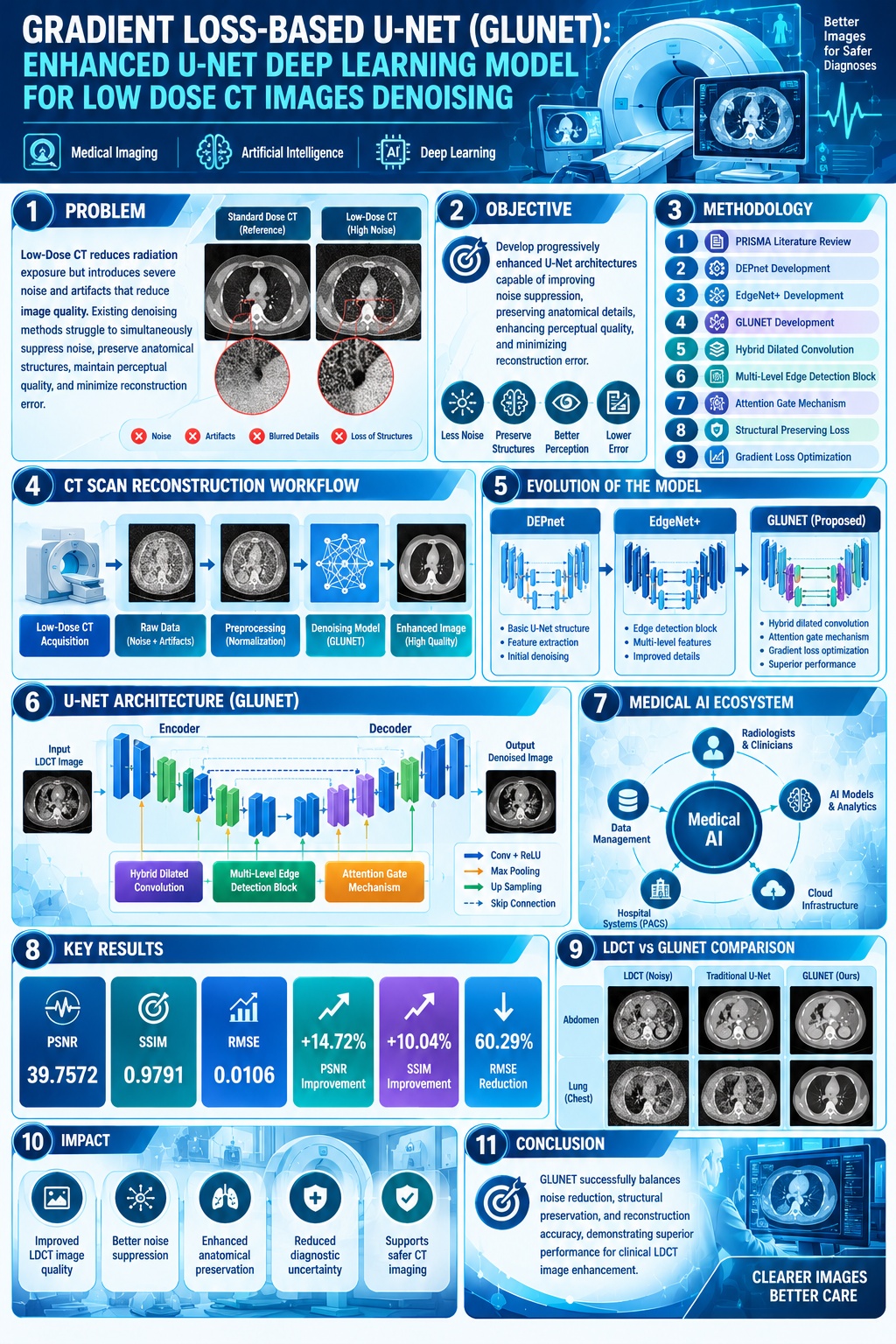
Multimedia Content:
01
Methodology
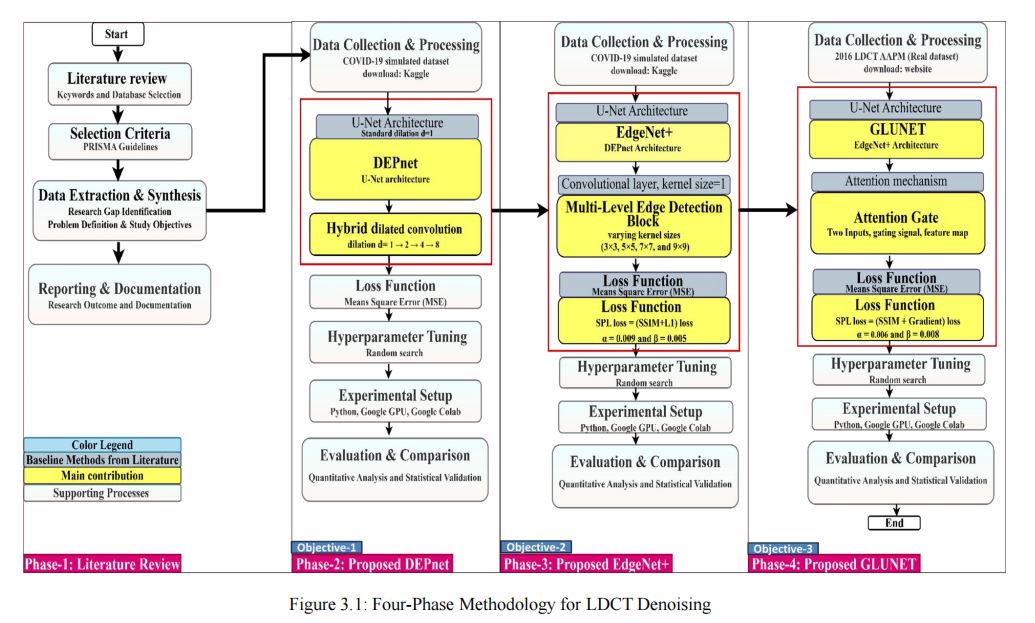
1. PRISMA-Guided Systematic Literature Review
The research began with a PRISMA-guided systematic literature review to identify existing LDCT image denoising techniques, determine current limitation...
View more
02
Citation Analysis
1. IEEE Transactions on Medical Imaging
Scope: Medical image analysis, computer-aided diagnosis, image reconstruction, and AI-based medical imaging.
Relevance: Highly relevant because the thesis f...
View more
03
Impact
1. Technical Impact
This research introduces three progressively enhanced deep learning architectures, namely DEPnet, EdgeNet+, and GLUNET, specifically designed to address noise suppression, edge ...
View more
04
Benefits to Society
Environmental Benefits
Although the research primarily focuses on medical imaging, improved AI-based image enhancement may contribute to more efficient healthcare resource utilization. Better recon...
View more
05
Applications
1. Application: Low-Dose CT Image Enhancement
Benefit: Improves image quality while maintaining low radiation exposure.
Implementation: The GLUNET framework can be integrated into CT reconstruct...
View more
06
Infographic
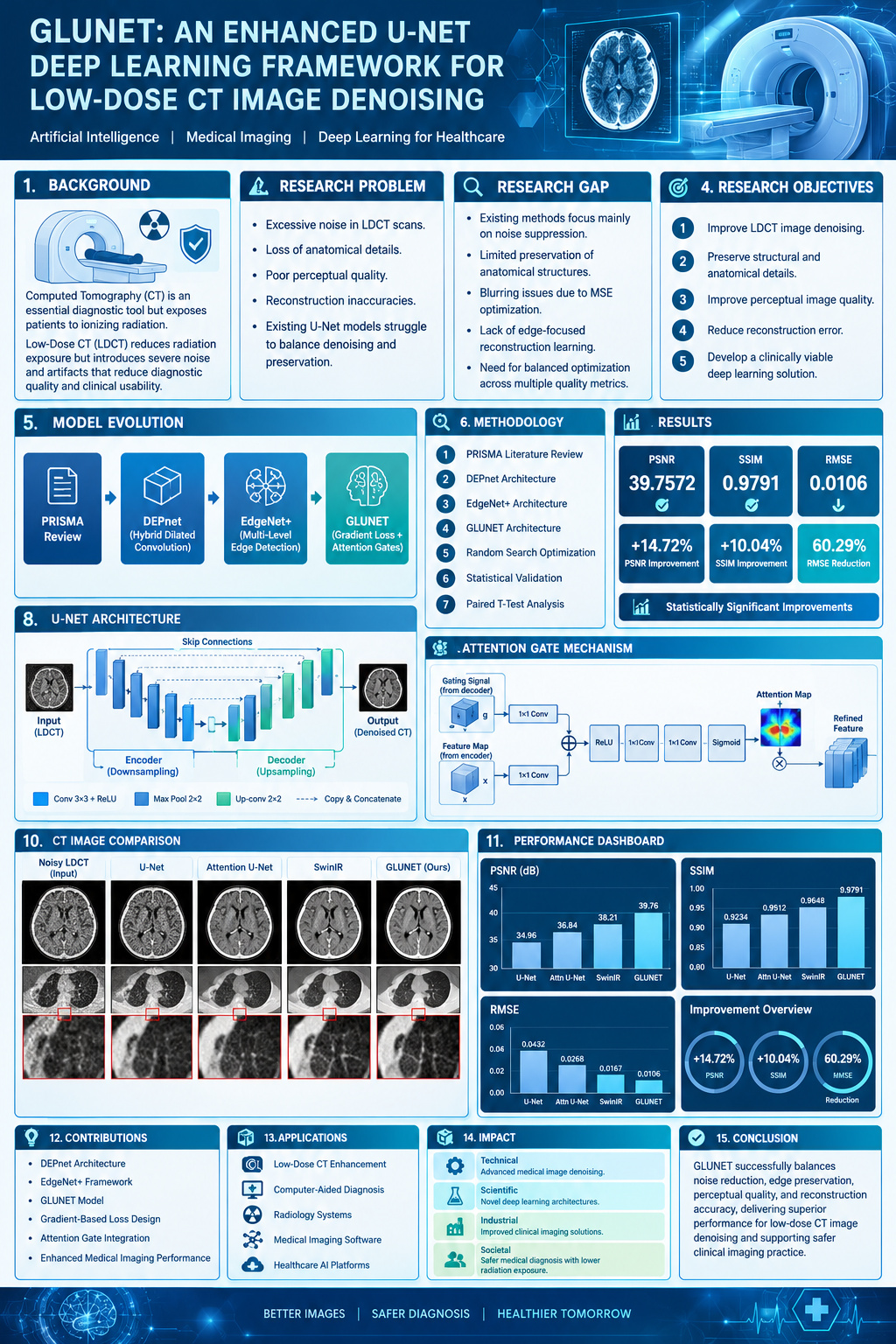
Summary of this Thesis
07
Patents / Products
Product Name:
GLUNET (Gradient Loss-Based U-Net for Low-Dose CT Denoising)
Significance:
GLUNET represents the primary innovation of the research and serves as an advanced deep-learning-based den...
View more
08
Experts
1. Ts. Lt. Dr. Helmi Bin Md Rais
Institution: Universiti Teknologi PETRONAS (UTP), Malaysia
Contribution: Main supervisor for the development of DEPnet, EdgeNet+, and GLUNET architectures.
Key Wo...
View more